

Dramastic Plastic
A 2-oscillator software synthesizer
App Overview
Technical Details
Dramastic Plastic is a desktop audio synthesizer designed for high-fidelity, real-time performance. It is built using a fast Rust audio engine paired with a web-based interface powered by Tauri. To guarantee lag-free audio and eliminate performance stutters, the core engine follows strict real-time coding standards—pre-allocating sound memory and passing internal state instantly through safe, lock-free communication channels.
The app keeps user inputs, background calculations, and raw digital signal processing strictly separated. It features high-quality, band-limited oscillators for rich vintage tones, alongside an intelligent voice-stealing system that manages polyphonic playing effortlessly.
Visually, the instrument integrates a custom particle simulation built in p5.js. Rather than relying on standard frequency analysis, this visualizer pulls knob configurations (such as LFO rates and filter cutoffs) directly from the backend to animate the flocking behaviors in real-time. Two overlapping, color-coded particle swarms adapt continuously to mirror the combined interactions of the dual oscillators.
About Presets
Customizing and managing sounds is central to the Dramastic Plastic experience. Understanding how presets are processed and saved helps you back up, trade, or manually tweak specific values.
How to Save a Preset
Capturing a unique configuration takes just a click. Once you adjust variables across both oscillators, assign a unique name via the dashboard presets console to anchor the patch directly inside standard libraries.
Where are Presets Saved?
On native Windows platforms, state exports reside safely inside your persistent local profile. These files are aggregated in the following directory path:
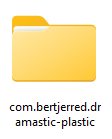
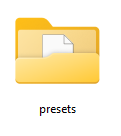
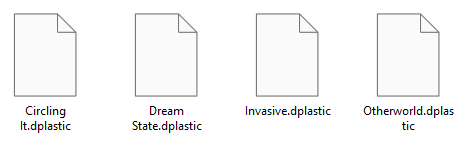
These modular files can be inspected securely using default utilities like Notepad.
What is a .dplastic file?
A .dplastic container formats data points using traditional, structured JSON syntax. It exposes precise operational properties (envelopes, attack speeds, wave vectors) making edits straightforward even outside the synthesizer software.
{
  "version": 2,
  "metadata": {
    "preset_name": "Dream State",
    "author": "Bert Jerred"
  },
  "osc1_settings": {
    "waveform": "Saw",
    "level": 0.538756,
    "adsr": {
      "attack": 2.752341311134235,
      "decay": 5.0,
      "sustain": 0.6463815789473685,
      "release": 1.009391790014653
    },
    "filter_cutoff": 112.94061886660609,
    "resonance": 0.35,
    "lfo": {
      "rate": 0.2567930935641735,
      "depth": 0.38,
      "shape": "Square"
    }
  },
  "osc2_settings": {
    "waveform": "Square",
    "level": 0.27040000000000003,
    "adsr": {
      "attack": 0.2897805212620027,
      "decay": 1.4,
      "sustain": 0.59375,
      "release": 2.100480109739369
    },
    "filter_cutoff": 318.424548476437,
    "resonance": 0.52,
    "lfo": {
      "rate": 0.4338956626347423,
      "depth": 0.21,
      "shape": "Triangle"
    }
  },
  "scope_settings": {
    "scale": 1.0,
    "offset": 0.0
  }
}